

 EN
EN ES
ES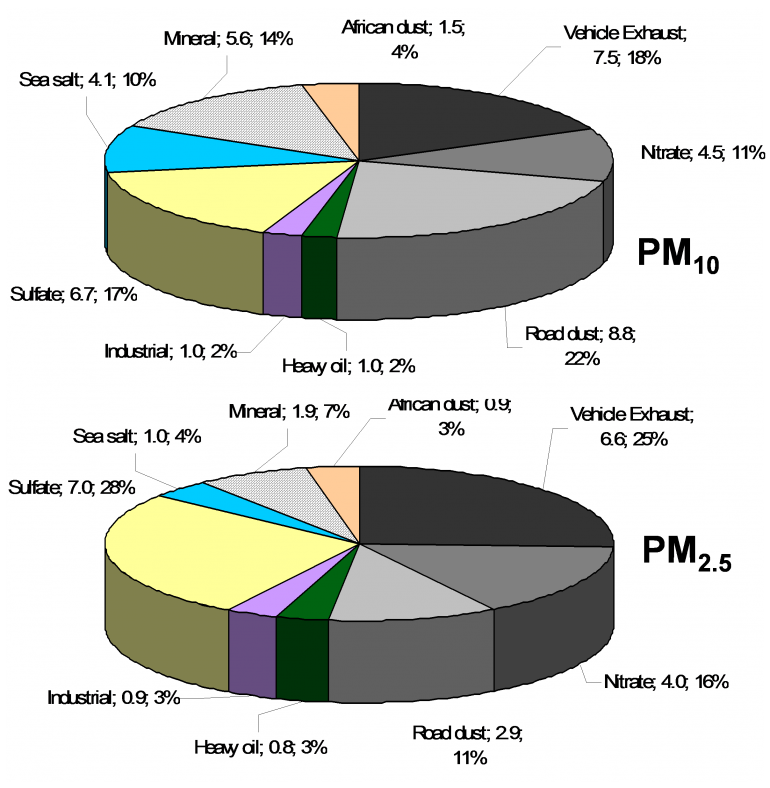
Airborne particles may be emitted by a variety of natural or anthropogenic sources, either directly in particulate form (primary particles) or by transformation of precursors (secondary particles). Applying receptor models to chemical databases of PM10 and PM2.5 it is possible to determine the main air pollutant sources and their contributions to particulate matter levels, these being vehicular traffic, mineral dust, industry, secondary sulphate, secondary nitrate, sea spray, and domestic and residential emissions.
 Traffic: This is the most common source of city particles, with typical contributions to the mass of up to 46% of PM10 and 48% of PM2.5 in urban areas. The source of vehicular traffic includes both direct emissions of primary particles from the exhaust of vehicles as well as resuspension of road dust generated by the vehicle movement.
Mineral matter: “Natural” minerals suspended within city air can be produced locally by emission processes such as construction, demolition, and roadworks, the movement of road vehicles, and resuspension by the wind throughout the city, but especially from dusty surfaces such as unpaved roads and some parks. In addition there is commonly a far-travelled “exotic” component, especially in Mediterranean countries where the arrival of air masses from the Sahara Desert with high mineral loads produces significant increases in the concentrations of coarser, sandy/silty particles.
Industrial: Industry is responsible for a wide range of PM contaminating the urban environment, deriving from specific sources such as those involving metallurgical, ceramic, power generation, petrochemical, and port emissio s. Each city will have its own array of industrial point source air pollution hotspots.
Sulphate: Given its high residence time in the atmosphere, the source of secondary sulphate is associated with mesoscale transport (industrial regional inputs) and the long distance movement of air masses. Ammonium sulphate is produced in the atmosphere from gaseous precursors such as SO2 (mainly from industry and ships), and NH3 (coming mostly from agricultural emissions).
Nitrate: The sources for nitrates are mainly associated with the formation of ammonium nitrate from gaseous precursors such as NO2 (mainly from traffic and industry), and NH3 (coming mostly from agricultural emissions).
Residential: Generally the contribution of private domestic sources to the levels of PM in ambient urban air is relatively low, and becomes mixed with contributions from regional sulphate and nitrate, and traffic emissions. A clear exception is in urban areas where there is significant residential coal burning.
Marine aerosol: Sea spray particles can be blown for long-distances in the atmosphere and so are almost always present in city air, although they obviously reach maximum contributions at coastal and island sites.
Adapted in part from Querol X., Viana M., Moreno T., Alastuey A, Pey J., Amato F., Pandolfi M., Minguillón M.C., Reche C., Pérez, N., González A., Pallarés M., Moral A., Monfort E., Escrig A., Cristóbal A., Hernández I., Miró J.V., Jiménez S., Reina F., Jabato R., Ballester F., Boldo E., Bellido J. Scientific bases for a National Air Quality Plan (In Spanish). Colección Informes CSIC, 3, 2012, ISBN 978-84-00-09475-1, 349 pp.